
 Blog Details
19-09-2026
In today's highly competitive manufacturing and food processing industries, maintaining product quality is more important than ever. Consumers expect clean, uniform, and defect-free products, while businesses strive to improve efficiency and reduce waste. To meet these demands, industries are increasingly adopting advanced automation technologies. One of the most effective solutions available is the Color Sorting Machine.
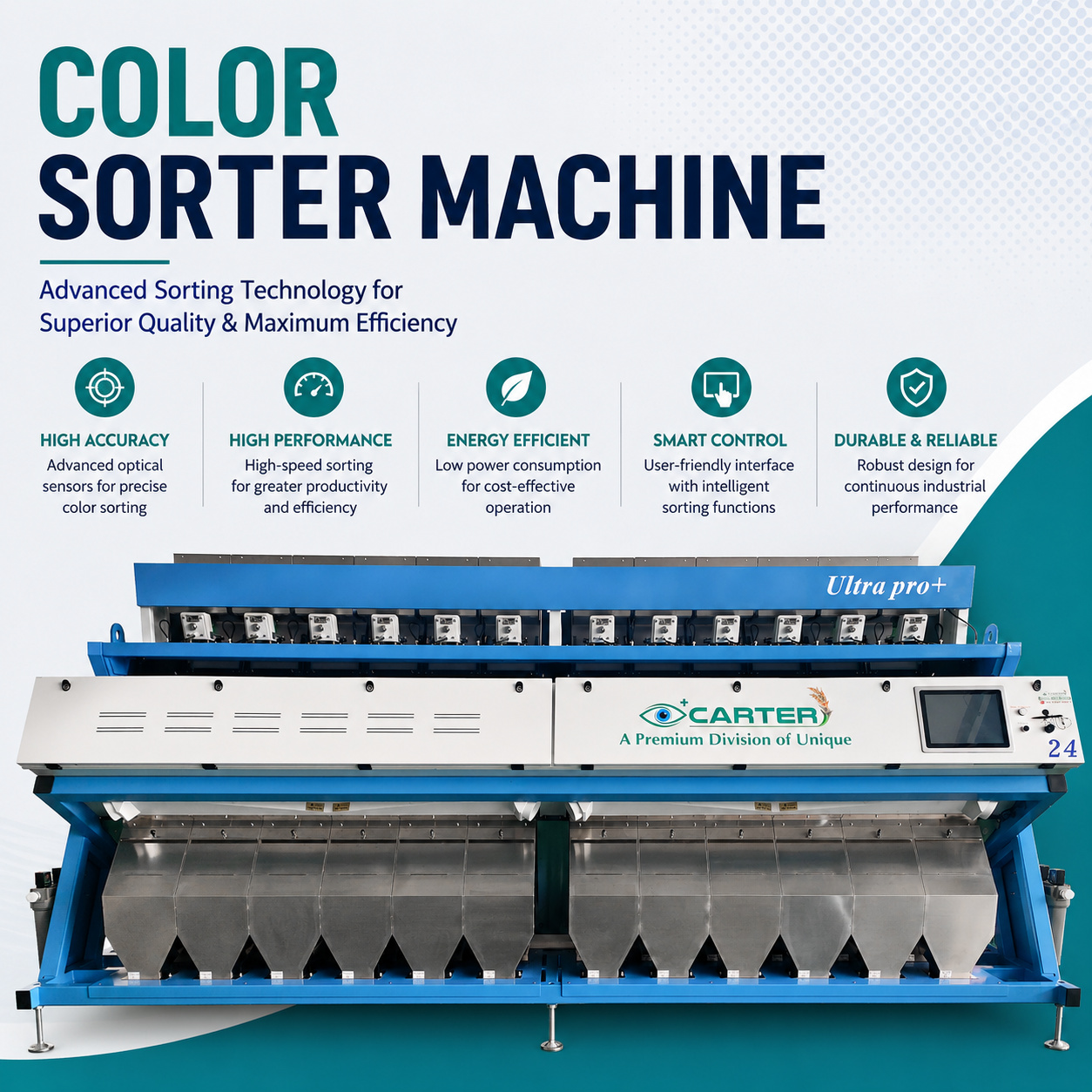
A Color Sorting Machine is an advanced optical sorting system designed to identify and separate defective, discolored, damaged, or foreign materials from a product stream. Using high-resolution cameras, intelligent sensors, and sophisticated image-processing software, these machines ensure that only high-quality products reach the market. From rice and grains to seeds, spices, plastics, and minerals, color sorting technology has become an essential part of modern production processes.
A Color Sorting Machine is an automated machine that sorts products based on differences in color, brightness, shape, and other visual characteristics. The machine uses optical sensors and cameras to inspect each item as it passes through the sorting area. Any material that does not meet the predefined quality standards is automatically removed using high-speed air ejectors.
Unlike manual sorting, which can be time-consuming and inconsistent, a Color Sorting Machine delivers fast, accurate, and reliable results. This technology helps businesses improve product quality, increase productivity, and reduce operational costs.
The working process of a Color Sorting Machine involves several advanced stages that ensure precise sorting and quality control.
The process begins when raw materials are fed into the machine through a hopper. A vibration feeder distributes the materials evenly across the sorting channels, ensuring smooth and consistent flow.
As the materials move through the machine, high-resolution cameras capture detailed images of each particle. Advanced LED lighting systems provide optimal illumination for accurate inspection.
The captured images are analyzed by intelligent software that compares each particle against predefined quality parameters. The system can detect color variations, defects, foreign materials, and impurities with exceptional precision.
Any particle that does not meet the required standards is instantly identified as defective or unwanted.
High-speed pneumatic ejectors remove the defective particles from the product stream. The accepted materials continue through the production process while rejected materials are collected separately.
This entire process occurs within milliseconds, allowing the machine to sort large volumes of materials efficiently and accurately.
One of the biggest advantages of a Color Sorting Machine is its ability to improve product quality. By removing defective and discolored materials, businesses can deliver premium-quality products that meet customer expectations.
Automated sorting significantly increases processing speed compared to manual inspection methods. Large quantities of materials can be sorted quickly without compromising accuracy.
Manual sorting requires a substantial workforce and can be prone to human error. A Color Sorting Machine reduces dependence on manual labor, helping businesses lower operational expenses.
Unlike human operators, machines maintain consistent performance throughout the production cycle. This ensures uniform quality and reliable sorting results.
Advanced optical technology minimizes the rejection of good products while effectively removing defective materials. This helps maximize yield and profitability.
In food processing industries, removing contaminants and foreign materials is critical. Color sorting technology enhances food safety by ensuring cleaner and safer products.
Although the initial investment may seem significant, the long-term benefits of improved efficiency, reduced waste, and lower labor costs provide excellent returns.
Rice manufacturers use Color Sorting Machines to remove yellow grains, damaged rice, black spots, and foreign particles. This improves the appearance and quality of the final product.
Wheat, maize, barley, and other grains can be sorted efficiently to eliminate impurities and defective kernels.
Color sorting helps remove damaged, discolored, and infected pulses, ensuring consistent quality and better market value.
Seed producers use color sorting technology to improve seed purity and quality. This contributes to better germination rates and agricultural productivity.
Spices often contain impurities, stems, and discolored particles. Color Sorting Machines help maintain product consistency and quality.
Tea leaves and coffee beans can be sorted based on color and appearance to achieve premium-grade products.
Recycling facilities use Color Sorting Machines to separate plastic materials based on color, improving recycling efficiency and material recovery.
Mining and industrial sectors use optical sorting technology to separate valuable materials from waste, increasing operational efficiency.
Modern Color Sorting Machines are equipped with advanced technologies that enhance performance and reliability.
Key features include:
These features enable businesses to achieve higher sorting accuracy and operational efficiency.
As industries continue to focus on quality assurance and automation, Color Sorting Machines have become an essential investment. They help businesses meet strict quality standards, improve customer satisfaction, and remain competitive in the market.
The ability to process large volumes of materials with exceptional accuracy makes color sorting technology a valuable asset for manufacturers and processors worldwide.
The future of Color Sorting Machines is driven by advancements in artificial intelligence, machine learning, and smart automation. Modern systems are becoming more intelligent, capable of identifying increasingly complex defects and adapting to changing production requirements.
Future innovations are expected to deliver even greater sorting accuracy, faster processing speeds, and enhanced operational efficiency. Businesses that invest in advanced sorting technology today will be better prepared for future industry demands.
A Color Sorting Machine is a powerful solution for industries seeking to improve product quality, increase productivity, and reduce operational costs. By utilizing advanced optical inspection systems and automated sorting technology, these machines provide accurate and reliable results across a wide range of applications.
Whether used in food processing, agriculture, recycling, or industrial manufacturing, Color Sorting Machines help businesses achieve higher quality standards and greater profitability. As technology continues to evolve, color sorting systems will play an increasingly important role in modern production environments, making them a smart investment for long-term success.
Copyright © 2024 Carter Unique Group. All Right Reserved.